Warehouses and distribution centers present a unique cleaning challenge.
Large floor areas, constant movement of employees and equipment, dust and debris, extended operating hours, and pressure to control labor costs can make it difficult to maintain consistent cleaning using traditional methods alone.
That’s one reason more facility operators are evaluating autonomous warehouse cleaning robots.
These commercial robots can automate repetitive tasks such as sweeping, scrubbing, vacuuming, and dust removal while allowing facility teams to focus their time on work that requires human attention.
But not every cleaning robot is designed for the same environment.
A 20,000-square-foot facility with mostly dust and loose debris may need a very different solution from a 250,000-square-foot distribution center operating multiple shifts.
In this guide, we’ll explain how warehouse cleaning robots work, where they can provide the most value, what to consider when selecting one, and some of the autonomous cleaning solutions available for large commercial and industrial facilities.
What Is a Warehouse Cleaning Robot?
A warehouse cleaning robot is a commercial autonomous machine designed to perform floor-cleaning tasks with limited operator involvement.
Depending on the robot, those tasks can include:
- Sweeping
- Scrubbing
- Vacuuming
- Dust mopping
- Spot cleaning
- Debris collection
Commercial cleaning robots are significantly different from residential robotic vacuums.
Warehouse environments can contain long aisles, racks, pallets, employees, forklifts, carts, loading areas, changing obstacles, and thousands of square feet of floor space.
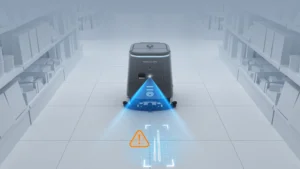
For that reason, commercial autonomous cleaning robots may use technologies such as LiDAR, cameras, VSLAM, sensors, mapping, and real-time obstacle detection to navigate the facility and complete assigned cleaning routes.
For example, ServicePro’s current PUDU MT1 specifications list a navigation system combining VSLAM, markers, and LiDAR SLAM. The newer MT1 Max adds a 3D perception system combining 3D LiDAR and multi-sensor fusion.
Why Are Warehouses Using Autonomous Cleaning Robots?
The purpose of automation isn’t simply to replace a traditional cleaning machine with a robot.
The larger opportunity is to automate repetitive floor coverage.
Consider a large distribution center where employees repeatedly spend hours sweeping the same aisles and open areas. Those are predictable, repetitive tasks that may be suitable for automation.
There are several reasons warehouse operators are exploring this approach.
1. Large Areas Require Significant Cleaning Time
Warehouses can contain enormous amounts of cleanable floor space.
The larger the facility becomes, the more employee hours may be required simply to maintain routine floor coverage.
An autonomous cleaning robot can be assigned to repetitive routes while employees handle cleaning tasks requiring greater judgment or manual attention.
2. Warehouse Floors Accumulate Debris Continuously
Dust, dirt, packaging material, paper, leaves, pallet debris, and other materials can accumulate throughout normal warehouse operations.
The cleaning requirement isn’t always a single end-of-day task. Some areas may need attention repeatedly throughout operating hours.
3. Warehouses Can Operate for Extended Hours
Distribution and fulfillment operations may run multiple shifts or operate nearly continuously.
Cleaning therefore has to fit around the operation rather than interrupt it.
Autonomous equipment can give facilities another option for scheduling repetitive cleaning tasks around their workflows.
4. Labor Can Be Redirected Toward Higher-Value Tasks
Floor cleaning is necessary, but manually driving a sweeper through the same large areas repeatedly can consume significant employee time.
Automation can allow cleaning teams to spend more time on tasks that require human judgment while the robot handles predictable floor coverage.
5. Consistency Matters
Manual cleaning performance can vary based on staffing, workload, shift, and available time.
Autonomous robots can follow predefined routes and cleaning schedules, helping organizations establish more repeatable cleaning processes.
Sweeper vs. Scrubber: What Type of Robot Does a Warehouse Need?
One of the biggest mistakes when evaluating warehouse cleaning robots is assuming that every facility needs the same machine.
It doesn’t.
The first question should be:
What exactly are you trying to remove from the floor?
Autonomous Sweepers
A robotic sweeper can be appropriate when the primary challenge is:
- Dust
- Dirt
- Paper
- Packaging debris
- Leaves
- Small loose materials
- Other dry debris
Large warehouses and distribution centers can be particularly strong applications for autonomous sweeping because of the amount of open hard-floor space.
Autonomous Scrubbers
A scrubber is designed for situations where sweeping alone isn’t sufficient.
These machines can be more appropriate for hard floors that require washing to remove dirt, marks, spills, or residue.
Multi-Function Cleaning Robots
Some facilities need more than one cleaning method.
Multi-function robots can combine capabilities such as sweeping, scrubbing, vacuuming, and mopping.
ServicePro’s Oscar platform, for example, combines sweeping, scrubbing, vacuuming, and mopping in a single autonomous platform.
The right choice therefore depends much more on the facility and cleaning requirement than on which robot has the longest feature list.
What Is the Best Cleaning Robot for a Warehouse?
There isn’t one cleaning robot that is best for every warehouse.
The right choice depends on factors including:
Facility size: How much actual cleanable floor area needs to be covered?
Floor type: Is the facility primarily concrete, polished concrete, epoxy, tile, carpet, or a combination?
Debris: Is the primary challenge fine dust, larger debris, floor residue, spills, or mixed cleaning?
Traffic: How frequently will employees, forklifts, carts, or other equipment cross the robot’s cleaning area?
Operating schedule: Does cleaning happen overnight, between shifts, or while operations continue?
Cleaning frequency: Does the entire facility need to be cleaned once daily, or do high-traffic areas need repeated attention?
Automation requirements: Does the organization need autonomous charging, waste disposal, water management, or other features?
Support: Who will help deploy, configure, train employees, maintain, and troubleshoot the equipment?
Those questions should come before choosing a particular model.
Warehouse Cleaning Robots to Consider
ServicePro Robotics offers multiple commercial cleaning solutions suitable for different large-facility requirements. Its current commercial cleaning catalog includes autonomous sweepers, scrubbers, multi-purpose cleaning robots, and outdoor cleaning equipment.
Here are several examples.
PUDU MT1 — Autonomous Sweeping for Large Areas
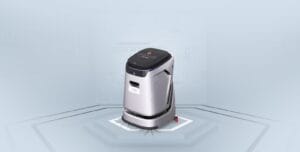
The PUDU MT1 is an AI-powered robotic sweeper designed for large-scale environments.
ServicePro currently lists maximum cleaning performance of approximately 1,800 m²/h (19,375 ft²/h) in standard cleaning mode and up to 6,000 m²/h (64,583 ft²/h) in spot-cleaning mode.
It has a 35-liter trash bin and a listed runtime of approximately 4–8 hours depending on cleaning level.
That makes the MT1 particularly relevant for warehouse environments where the main objective is removing dust and loose debris across large hard-floor areas.
ServicePro also lists an optional automatic garbage-disposal base station for the MT1, allowing the robot to automatically empty its onboard container based on bin-full detection or a configured schedule.
Potential fit: warehouses, logistics facilities and large areas requiring repetitive dry sweeping.
PUDU MT1 Max — Higher-Capacity Autonomous Sweeping
For larger or more demanding environments, the MT1 Max expands on the MT1 platform.
ServicePro lists maximum cover-cleaning performance of 2,200 m²/h (23,681 ft²/h) and spot-cleaning performance up to 7,000 m²/h (75,347 ft²/h).
Its listed runtime ranges from 5–10 hours, with approximately eight hours under standard operation.
The MT1 Max also incorporates 3D LiDAR and multi-sensor fusion for environmental perception and obstacle detection. ServicePro describes features specifically related to dynamic vehicle avoidance, including the ability to respond to vehicles and activity around lane entrances.
Those capabilities make it particularly interesting for larger, more dynamic commercial and industrial environments.
Potential fit: large warehouses, distribution centers and facilities with substantial dry-floor sweeping requirements.
MT1 Vac — Sweeping, Vacuuming and Dust Mopping
Not every warehouse environment requires traditional sweeping alone.
The MT1 Vac combines sweeping, vacuuming, and dust mopping.
ServicePro currently lists maximum cleaning performance of 1,400 m²/h, runtime between approximately 3 and 6.5 hours depending on operating conditions, and H11 filtration with optional H13 filtration.
Potential fit: facilities where dust collection and vacuuming are particularly important.
Oscar Pro — Multi-Purpose Autonomous Cleaning
For environments requiring multiple cleaning methods, Oscar Pro offers a different approach.
The platform supports sweeping, scrubbing, vacuuming, and mopping and combines visual positioning with LiDAR navigation.
ServicePro lists different runtimes by cleaning mode, including approximately five hours for scrubbing and sweeping/vacuuming and up to nine hours for silent mopping.
Rather than being dedicated primarily to large-scale sweeping, Oscar Pro may be relevant when a facility needs more flexibility across different cleaning tasks or floor conditions.
Potential fit: mixed commercial environments requiring several cleaning modes.
AGIBOT C5 — Autonomous Scrubbing for Large Hard Floors
If a warehouse needs floor washing rather than primarily dry sweeping, a scrubber may make more sense.
The AGIBOT C5 combines sweeping, scrubbing, and dust mopping.
ServicePro currently lists a 90-liter water tank, 550 mm washing width, three hours of scrubbing endurance, and maximum cleaning efficiency of 1,980 m²/h. The robot can also work with a workstation for charging, wastewater disposal, tank rinsing, and fresh-water refilling.
Potential fit: industrial and commercial facilities requiring routine hard-floor scrubbing.
Warehouse Cleaning Robot Comparison
Here’s a simplified way to think about these solutions:
| Robot | Primary cleaning | Potential warehouse use |
|---|---|---|
| PUDU MT1 | Sweeping | Large-area dry debris cleaning |
| PUDU MT1 Max | High-capacity sweeping | Larger and more demanding warehouse environments |
| MT1 Vac | Sweep + vacuum + dust mop | Dust-sensitive environments |
| Oscar Pro | Sweep + scrub + vacuum + mop | Mixed cleaning requirements |
| AGIBOT C5 | Sweep + scrub + dust mop | Hard-floor washing and scrubbing |
This comparison shouldn’t replace an actual facility assessment.
A warehouse with 50,000 square feet of cleanable concrete and light dust has different requirements from a 500,000-square-foot distribution facility with constant forklift traffic and larger debris.
How to Choose a Warehouse Cleaning Robot
Before requesting pricing or comparing specifications, facility teams should document their actual cleaning environment.
1. Measure the Cleanable Area
Total building size isn’t necessarily the number that matters.
A 300,000-square-foot warehouse may contain racks, equipment, offices, storage areas, and spaces a robot will never clean.
Calculate the approximate accessible floor area instead.
2. Identify Your Floor Types
Determine whether the robot will encounter:
- Concrete
- Polished concrete
- Epoxy
- Tile
- Carpet
- Mixed flooring
ServicePro already provides a separate guide covering the types of floors commercial cleaning robots can clean.
3. Identify the Main Cleaning Problem
Ask what your team spends the most time doing today.
Is it:
- Sweeping dust?
- Collecting loose debris?
- Removing floor residue?
- Scrubbing?
- Vacuuming?
- Cleaning spills?
- Maintaining multiple floor types?
That answer helps determine whether you should begin by evaluating a sweeper, scrubber, vacuuming platform, or multi-purpose robot.
4. Understand Facility Traffic
Warehouse automation doesn’t happen in an empty building.
Consider interactions with:
- Employees
- Forklifts
- Pallet jacks
- Carts
- Equipment
- Temporary obstacles
- Loading areas
The more dynamic the environment, the more important it becomes to test the robot under actual operating conditions.
5. Consider the Entire Deployment
Robot specifications are only one part of the investment.
Organizations should also consider implementation, mapping, charging, employee training, maintenance, technical support, and potential expansion to additional areas or locations.
Can Cleaning Robots Work Around Forklifts and Employees?
Modern commercial cleaning robots are designed with sensors and navigation systems intended to detect and respond to obstacles.
However, that doesn’t mean every robot is automatically appropriate for every warehouse.
Warehouse traffic patterns can be complex and highly specific to the operation.
For example, the MT1 Max includes a 3D perception system and ServicePro describes dedicated dynamic vehicle and pedestrian avoidance capabilities.
Even with those technologies, organizations should evaluate how a robot behaves in their actual environment before making assumptions about large-scale deployment.
That is one reason a demonstration or proof of concept can be valuable.
Should You Test a Cleaning Robot Before Buying?
For larger facilities, testing can be one of the most useful steps in the evaluation process.
Instead of evaluating automation exclusively through specification sheets, a facility can assess the robot against its real:
- Floor conditions
- Debris
- Aisles
- Obstacles
- Traffic
- Cleaning schedule
- Operational workflow
A proof of concept can then help answer more meaningful questions:
How much floor area can the robot realistically cover in our facility?
What cleaning tasks can we automate?
How frequently will employees need to interact with it?
How does it perform around our normal operation?
Could the solution scale to other areas or locations?
Those answers are more useful than selecting a robot based only on theoretical maximum productivity.
Are Warehouse Cleaning Robots Worth It?
The answer depends on the operation.
Rather than asking whether autonomous cleaning robots are universally “worth it,” facility managers should compare the robot against the current cost and operational requirements of the cleaning task being automated.
Consider:
- Employee hours currently spent on repetitive floor cleaning
- Frequency of cleaning
- Amount of floor area
- Current equipment costs
- Cleaning consistency
- Staffing challenges
- Required supervision
- Robot purchase or leasing costs
- Maintenance and support
- Potential utilization throughout the day
For some organizations, the value may come primarily from labor efficiency.
For others, it may come from cleaning consistency, increased floor coverage, extended cleaning schedules, or the ability to redirect employees toward more valuable work.
The business case should be built around measurable operational results rather than a generic ROI promise.
Frequently Asked Questions About Warehouse Cleaning Robots
What is the best autonomous cleaning robot for a warehouse?
There is no single best robot for every warehouse. Large facilities primarily dealing with dry debris may benefit from an autonomous sweeper such as the MT1 or MT1 Max, while facilities requiring hard-floor washing may need an autonomous scrubber. Facility size, floor type, debris, traffic, and cleaning schedule should all be evaluated before choosing a robot.
Can a robot clean a large warehouse?
Commercial cleaning robots are specifically available for large-area cleaning, but actual coverage depends on the model, cleaning mode, runtime, facility layout, charging strategy, and operating conditions.
Can warehouse cleaning robots work around forklifts?
Some commercial autonomous cleaning robots include obstacle detection and navigation capabilities designed for dynamic environments. The MT1 Max, for example, includes features specifically designed for dynamic vehicle avoidance. The suitability of any robot should still be evaluated in the actual facility.
Can warehouse cleaning robots sweep and scrub?
Yes, depending on the model. Some robots specialize in sweeping, while others can scrub, vacuum, mop, or combine multiple cleaning functions.
How much does a warehouse cleaning robot cost?
Pricing varies significantly based on the robot, capabilities, accessories, deployment requirements, and purchase or leasing arrangement. ServicePro currently provides purchase and leasing options for multiple commercial cleaning robots.
Do cleaning robots completely replace warehouse cleaning staff?
That shouldn’t necessarily be the objective. A more practical use of automation is assigning repetitive floor-cleaning tasks to robots while allowing employees to concentrate on tasks requiring human judgment, detailed cleaning, maintenance, and other facility responsibilities.
Can we test a warehouse cleaning robot before purchasing?
A demonstration or proof of concept can help determine whether a particular cleaning robot is appropriate for the facility before an organization considers broader deployment.
Find the Right Cleaning Robot for Your Warehouse
There is no reason to choose a warehouse cleaning robot based on specifications alone.
The right solution depends on what you’re cleaning, how much floor area you need to cover, your facility’s traffic patterns, your operating schedule, and the cleaning tasks you want to automate.
ServicePro Robotics offers a range of autonomous commercial cleaning solutions, including robotic sweepers, scrubbers, vacuuming systems, and multi-purpose cleaning platforms.
Whether you’re evaluating automation for one warehouse or considering deployment across multiple facilities, the first step is understanding which solution fits your actual operation.
Ready to see how autonomous cleaning could work in your warehouse?
Request a Cleaning Robot Demo
Talk with ServicePro Robotics about your facility, cleaning requirements, and automation goals to identify the right robot and determine whether a demonstration or proof of concept makes sense.