Labor is one of the largest ongoing expenses in commercial cleaning.
For warehouses, manufacturing plants, schools, hotels, retail facilities, and other large commercial environments, floor cleaning can require employees to spend hours performing the same repetitive tasks every day.
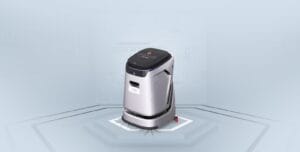
Autonomous cleaning robots provide another approach.
Instead of assigning employees to manually sweep or scrub large floor areas throughout an entire shift, facilities can automate repetitive floor-cleaning routes while their teams focus on tasks that still require human attention.
The result is not simply “replacing labor with robots.” The larger opportunity is using existing labor more efficiently.
Why Are Janitorial Labor Costs Increasing?
Commercial cleaning operations face several labor challenges.
Hourly wages and employment costs can increase while facilities still need to maintain consistent cleaning standards. At the same time, employee turnover, hiring difficulties, absenteeism, overtime, and repetitive workloads can make cleaning operations harder to manage.
Large facilities create an additional challenge: square footage.
The larger the facility, the more employee hours may be required simply to keep floors consistently clean.
Automation can help organizations separate repetitive cleaning work from tasks that actually require human judgment.
What Cleaning Tasks Can Robots Automate?
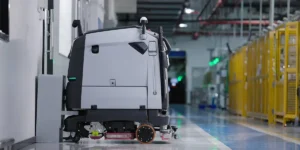
Commercial cleaning robots are primarily designed to automate repetitive floor-care tasks.
Depending on the robot, these can include:
Sweeping — collecting dust and debris across large floor areas.
Scrubbing — cleaning hard floors using automated scrubbing systems.
Vacuuming — maintaining carpeted or other compatible surfaces.
Mopping — providing routine hard-floor maintenance.
Some autonomous cleaning platforms can perform multiple cleaning functions within the same system.
This allows facilities to assign predictable floor-cleaning routes to robots while employees handle restrooms, surfaces, spills, detailed cleaning, inspections, replenishment, and other tasks requiring human involvement.
How Can Cleaning Robots Reduce Labor Costs?
The key metric is not simply how many employees a robot can replace.
A better question is:
How many repetitive cleaning hours can the facility automate?
Consider a facility where employees collectively spend several hours every day sweeping or scrubbing large open areas.
If an autonomous robot can perform part of that workload independently, those employee hours can potentially be redirected to higher-value cleaning activities.
Over weeks, months, and multiple locations, those recovered labor hours can become significant.
Cleaning Robots vs. Manual Floor Cleaning
Manual floor cleaning requires an employee to operate cleaning equipment throughout the task.
Autonomous cleaning changes that relationship.
An employee can configure or start a cleaning mission and then move on to another responsibility while the robot performs its assigned route.
This creates the possibility of parallel productivity:
The robot cleans the floor while the employee performs another task.
For facility managers, this distinction is important because the value of automation is not only the cleaning output produced by the robot. It also includes the productive time made available elsewhere in the operation.
Where Can Cleaning Automation Have the Greatest Labor Impact?
The strongest opportunities are generally environments with substantial amounts of repetitive floor cleaning.
Warehouses and Distribution Facilities
Large floor areas and long aisles can require significant manual sweeping and floor maintenance.
Autonomous cleaning robots can perform scheduled cleaning routes while warehouse teams focus on other operational responsibilities.
Manufacturing Plants
Manufacturing facilities often require frequent cleaning while employees must also work around equipment, production areas, and operational schedules.
Automation can help maintain large accessible floor areas consistently.
Schools and Universities
Educational facilities may contain hallways, cafeterias, gymnasiums, common areas, and other large spaces requiring regular floor cleaning.
Automating some of those areas can help custodial teams concentrate on classrooms, restrooms, surfaces, and detailed cleaning.
Hotels and Hospitality
Cleaning teams have many responsibilities beyond floors.
Autonomous floor cleaning can complement employees responsible for guest-facing and detail-oriented tasks.
Retail and Large Commercial Facilities
Large stores and commercial buildings can use autonomous cleaning to maintain floor areas consistently without assigning an employee exclusively to operate floor-cleaning equipment.
Calculate Your Current Cost per Cleaning Hour
Before evaluating automation, facilities should understand their existing cleaning costs.
Start with factors such as:
- Employee hours dedicated to floor cleaning
- Hourly labor costs
- Overtime
- Frequency of cleaning
- Square footage cleaned
- Equipment operating costs
- Number of shifts
- Supervisor involvement
Then compare those costs against the expected productivity and operating cost of an autonomous cleaning solution.
This provides a more useful comparison than looking only at the purchase price of a robot.
Don’t Evaluate a Cleaning Robot on Price Alone
Two robots with different prices may produce very different operational results.
A facility should also evaluate:
Cleaning productivity
How much usable floor area can the robot clean during actual operations?
Autonomy
How frequently does an employee need to intervene?
Runtime
Can the robot complete the required cleaning routes within the available operating window?
Navigation
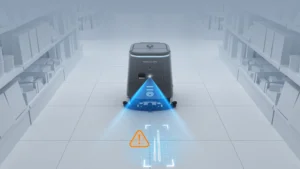
Can it operate effectively around people, equipment, carts, inventory, and other obstacles?
Cleaning capabilities
Does the facility need sweeping, scrubbing, vacuuming, mopping, or multiple functions?
Scalability
Can the solution be expanded to additional areas or facilities if the initial deployment is successful?
These factors influence the true cost of cleaning automation.
Can Cleaning Robots Completely Replace Janitorial Staff?
For most facilities, that should not be the starting assumption.
Cleaning operations involve many tasks that autonomous floor-cleaning robots are not designed to perform.
The more practical model is human + robot collaboration.
Robots handle predictable, repetitive floor-cleaning work while employees focus on tasks requiring dexterity, judgment, interaction, detailed cleaning, and problem-solving.
This can help organizations improve productivity without expecting one technology to automate the entire cleaning operation.
How Do You Know If Cleaning Automation Will Save Money?
The most reliable way is to evaluate the technology against your actual operation.
Identify the floor-cleaning workload you want to automate, estimate the labor currently required, and measure how effectively an autonomous robot performs that work.
For larger deployments, a proof of concept can provide real-world data before an organization makes a larger investment.
Instead of asking only:
“How much does the robot cost?”
Ask:
“How much does our current cleaning process cost, and how could automation change that cost?”
That is the foundation of a stronger automation business case.
Start With Your Facility
Every cleaning operation is different.
Floor type, square footage, traffic, debris, cleaning schedules, staffing, and operating hours all influence which autonomous cleaning solution makes sense.
ServicePro Robotics works with organizations to evaluate commercial cleaning automation based on their actual facility requirements.
To estimate savings for your own site, see our guide to building a cleaning robot business case. Buildings with both carpet and hard floors may benefit from multi-purpose robots, while large open floors are usually better served by autonomous floor scrubbers.
See What Cleaning Automation Could Save Your Facility
Evaluate your current cleaning workload, identify opportunities for automation, and determine which commercial cleaning robot best fits your operation.
Talk to a ServicePro Robotics Automation Specialist