Manufacturing plants can be some of the most demanding environments to keep clean.
Production areas may operate for extended hours while employees, forklifts, carts, machinery, and materials continuously move throughout the facility.
At the same time, floors can accumulate:
- Dust
- Dirt
- Packaging debris
- Production debris
- Tire and wheel marks
- Residue
- Spills
- Material carried between production areas
Traditional cleaning equipment can handle these challenges, but it often requires an employee to operate the machine throughout the cleaning process.
That is where autonomous cleaning robots can provide another option.
Modern industrial cleaning robots can automate repetitive sweeping, scrubbing, vacuuming, and floor-cleaning routes while allowing facility teams to focus on tasks that require human attention.
However, choosing the right cleaning robot for a manufacturing plant requires more than comparing specifications.
The facility, floor conditions, production environment, traffic, debris, and cleaning requirements all matter.
Why Manufacturing Plants Are Exploring Autonomous Cleaning
Cleaning automation isn’t simply about replacing a traditional floor-cleaning machine.
The bigger opportunity is automating repetitive floor coverage.
A manufacturing plant may require the same aisles, production areas, staging zones, and common spaces to be cleaned repeatedly.
If employees spend several hours operating sweepers or scrubbers across those areas every day, autonomous equipment may allow some of that repetitive workload to be automated.
Potential benefits include:
More Consistent Cleaning
Autonomous robots can follow planned cleaning routes repeatedly, helping facilities maintain more consistent floor-cleaning schedules.
Better Use of Labor
Instead of spending an entire shift driving a cleaning machine, employees may be able to focus on detailed cleaning, equipment maintenance, sanitation, inspections, or other facility responsibilities.
Extended Cleaning Schedules
Depending on the robot and facility, autonomous cleaning can potentially operate during production hours, between shifts, or during lower-traffic periods.
Repeatable Floor Coverage
Mapped cleaning routes can make it easier to establish repeatable cleaning processes across large areas.
What Types of Cleaning Robots Can Manufacturing Plants Use?
Not every manufacturing plant has the same cleaning problem.
The first step is identifying what needs to be removed from the floor.
Autonomous Sweepers
Industrial sweepers are designed primarily for loose material such as:
- Dust
- Dirt
- Paper
- Packaging material
- Small debris
- Dry production debris
They can be particularly useful in large facilities where dry debris accumulates continuously.
Autonomous Floor Scrubbers
Scrubbers are better suited to hard floors requiring wet cleaning.
They may be appropriate for:
- Floor marks
- Attached dirt
- Residue
- Routine floor washing
- High-traffic hard surfaces
Multi-Purpose Cleaning Robots
Some manufacturing environments contain several different areas and floor-cleaning requirements.
Multi-purpose robots can combine capabilities such as:
Sweeping + Scrubbing + Vacuuming + Mopping
This can make them useful where one cleaning method isn’t enough.
Cleaning Robots to Consider for Manufacturing Facilities
ServicePro Robotics currently offers several autonomous cleaning systems that may fit different industrial environments.
Rather than asking which one is universally “best,” manufacturers should match the robot to the cleaning problem.
PUDU MT1 — Autonomous Sweeping for Large Indoor Areas
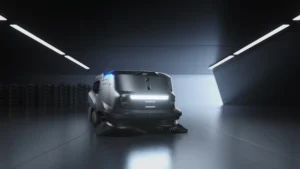
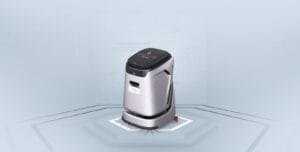
The PUDU MT1 is an AI-powered robotic sweeper designed for large-area cleaning.
ServicePro currently lists maximum standard cleaning performance of approximately 1,800 m²/h (19,375 ft²/h) and spot-cleaning performance up to 6,000 m²/h (64,583 ft²/h).
It has a 35-liter trash bin, approximately 4–8 hours of runtime, and uses VSLAM, markers, and LiDAR SLAM for navigation.
ServicePro also offers an optional automatic garbage-disposal base station that can empty the MT1’s onboard container automatically.
Potential manufacturing fit
The MT1 may be worth evaluating for:
large indoor production areas, warehouses connected to manufacturing facilities, dry debris, dust, and repetitive sweeping routes.
PUDU MT1 Max — For Larger and More Demanding Sweeping Environments
For facilities requiring greater sweeping capacity, the MT1 Max provides another option.
ServicePro currently lists maximum cover-cleaning performance of approximately 2,200 m²/h (23,681 ft²/h) and spot cleaning up to 7,000 m²/h (75,347 ft²/h).
Runtime is listed at approximately 5–10 hours, with around eight hours in standard mode.
This makes it particularly interesting for facilities where a robot may need to cover substantial floor area during longer operating periods.
Potential manufacturing fit
Large factories, production facilities, logistics areas, and manufacturing environments with significant dry-floor sweeping requirements.
AGIBOT C5 — For Industrial Floor Scrubbing
Dry debris isn’t the only cleaning challenge inside manufacturing plants.
Some environments require frequent hard-floor washing.
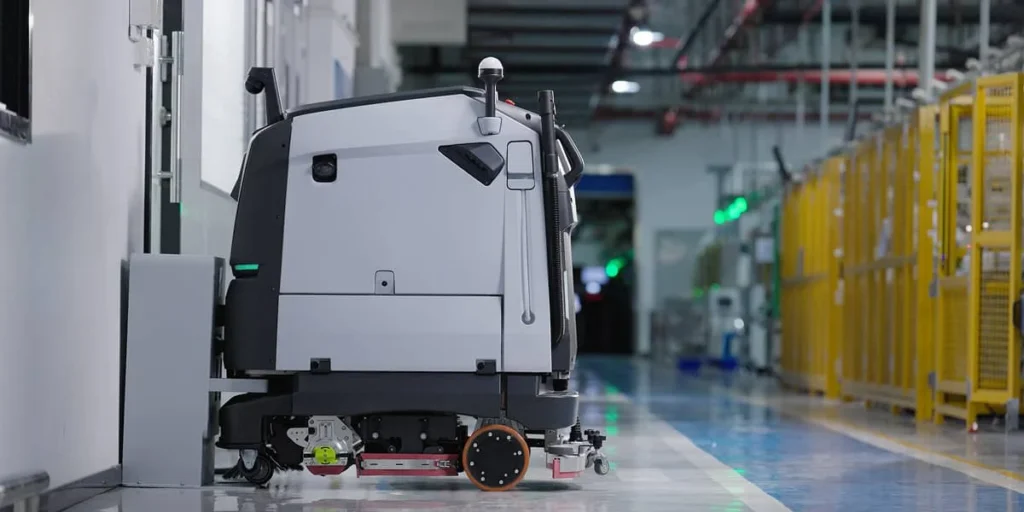
The AGIBOT C5 combines:
Sweeping + Scrubbing + Dust Mopping
ServicePro lists a maximum cleaning efficiency of approximately 1,980 m²/h, a 90-liter water-tank volume, 25 kg of scrubbing pressure, and a 550 mm washing width.
Its workstation can also support automatic:
- Charging
- Fresh-water refilling
- Wastewater disposal
- Sewage-tank rinsing
ServicePro specifically lists industrial buildings among the environments where C5 can be deployed.
Potential manufacturing fit
Factories and industrial environments requiring repeated hard-floor scrubbing rather than dry sweeping alone.
SC50 — Autonomous Scrubbing for Small and Medium Industrial Areas
Not every factory requires a large industrial cleaning platform.
The SC50 is an autonomous floor scrubber that ServicePro positions for small and medium-sized indoor environments, including industrial settings.
Its navigation combines laser, RGBD, ultrasonic, anti-collision, and other sensor technologies.
ServicePro also lists automatic charging, water filling/draining, missed-area cleaning, and breakpoint resumption among its automation capabilities.
Potential manufacturing fit
Small and medium production facilities or specific factory zones requiring regular autonomous floor scrubbing.
Which Robot Is Best for a Manufacturing Plant?
There isn’t one answer.
A useful starting point is:
| Manufacturing Challenge | Robot Type to Consider |
|---|---|
| Dust and loose debris | Autonomous sweeper |
| Packaging debris | Autonomous sweeper |
| Large dry production floors | MT1 / MT1 Max |
| Dirty hard floors | Autonomous scrubber |
| Repeated floor washing | AGIBOT C5 / SC50 |
| Multiple cleaning requirements | Multi-purpose cleaning robot |
| Outdoor factory areas | Commercial outdoor sweeper |
The exact robot should still be selected based on the facility itself.
Sweeper vs. Scrubber in Manufacturing
This is one of the most important distinctions.
Consider two factories.
Factory A
The primary problem is:
Dust, cardboard fragments, packaging material and other dry debris.
An autonomous sweeper may make more sense.
Factory B
The primary problem is:
Floor marks, dirt attached to the surface and residue requiring regular washing.
An autonomous scrubber may be the better option.
Factory C
The facility has both problems.
In this case, the right solution could involve a multi-function robot or a combination of sweeping and scrubbing equipment.
This is why selecting a cleaning robot based only on facility size can lead to the wrong solution.
Can Cleaning Robots Operate Around Employees and Forklifts?
Manufacturing plants are dynamic environments.
A robot may encounter:
- Employees
- Forklifts
- Pallet jacks
- Carts
- Materials
- Temporary obstacles
- Changing production layouts
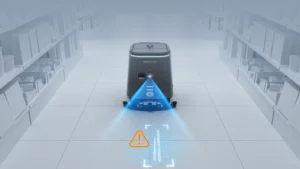
Modern commercial robots use combinations of LiDAR, cameras and other sensors to perceive their surroundings.
However, a robot having obstacle-detection technology doesn’t automatically mean it is appropriate for every production environment.
Traffic patterns should be evaluated during deployment.
For busy manufacturing plants, a real-world demonstration or proof of concept is particularly valuable.
What Floor Types Can Industrial Cleaning Robots Handle?
Manufacturing facilities commonly contain surfaces such as:
- Concrete
- Polished concrete
- Sealed concrete
- Epoxy
- Tile
- Mixed hard flooring
But floor material is only part of the equation.
Facilities should also consider:
floor condition, surface texture, slopes, thresholds, drainage areas, chemicals, debris, production residue and cleaning requirements.
The cleaning configuration should be appropriate for both the floor and the material being removed.
How to Choose a Cleaning Robot for Your Manufacturing Plant
Before choosing a robot, conduct a basic facility assessment.
1. Measure the Cleanable Area
Don’t use total building square footage.
Calculate how much floor the robot can realistically access.
2. Identify Your Main Cleaning Problem
Is the problem dust? Packaging debris? Residue? Tire marks? Spills? General dirt?
This helps determine whether you need sweeping or scrubbing.
3. Map Facility Traffic
Identify where forklifts, employees, carts and other equipment move throughout the day.
4. Review the Cleaning Schedule
Determine how often each area needs cleaning and when autonomous cleaning could realistically operate.
5. Calculate Current Cleaning Labor
Understand how many employee hours are currently spent performing repetitive floor-cleaning tasks.
6. Evaluate Deployment Requirements
Consider charging, water, waste disposal, mapping, training, maintenance and support—not just the robot itself.
Can Cleaning Robots Reduce Manufacturing Cleaning Costs?
Potentially, but the calculation should be based on the actual facility.
The wrong way to calculate ROI is to assume:
one robot = one employee eliminated.
A better calculation considers:
How many repetitive cleaning hours can realistically be automated?
Then evaluate:
- Current labor hours
- Cleaning frequency
- Facility size
- Robot utilization
- Equipment costs
- Maintenance
- Purchase or leasing costs
- Remaining manual cleaning
- Operational consistency
The business case becomes stronger when the robot can be used consistently rather than occasionally.
This is also why large manufacturing environments can be particularly interesting candidates for automation.
Should Manufacturers Test a Cleaning Robot Before Buying?
For complex industrial environments, testing is one of the most useful steps in the buying process.
A demonstration or proof of concept can help determine:
Can the robot navigate our actual production environment?
How does it respond to employees and equipment?
Can it clean our actual debris?
How much floor area can it realistically cover?
How much human intervention does it require?
Can it operate within our production schedule?
Does the cleaning result meet our requirements?
These answers are much more valuable than selecting a robot from a specification sheet alone.
Cleaning Robots for Manufacturing Plants: FAQ
What is the best cleaning robot for a manufacturing plant?
There is no universal best model. Facilities primarily dealing with dry debris may benefit from an autonomous sweeper such as the MT1 or MT1 Max, while facilities requiring hard-floor washing may need an autonomous scrubber such as AGIBOT C5 or SC50.
Can robots clean large factories?
Commercial cleaning robots are available for large-area applications. Actual coverage depends on the robot, cleaning mode, runtime, facility layout and operating conditions.
Can cleaning robots work around forklifts?
Commercial robots can use sensors and autonomous navigation to detect obstacles, but suitability should be evaluated in the facility’s actual traffic environment.
Can a cleaning robot sweep and scrub?
Some can. For example, ServicePro describes AGIBOT C5 as combining sweeping, scrubbing and dust mopping.
How much does an industrial cleaning robot cost?
Pricing depends on the robot, capabilities, accessories, workstation, support and purchase or leasing structure. This question can naturally link to your new Commercial Cleaning Robot Pricing Guide.
Do cleaning robots replace manufacturing cleaning staff?
A better use case is automating repetitive floor-cleaning tasks while employees focus on cleaning and facility responsibilities that require human judgment.
Can we test a robot before deploying it throughout a factory?
A demonstration or proof of concept can be used to evaluate cleaning performance, navigation and workflow fit before considering a broader deployment.
Automate Repetitive Floor Cleaning in Your Manufacturing Facility
Manufacturing plants don’t all need the same cleaning robot.
A facility dealing primarily with dust and loose production debris may need a powerful autonomous sweeper.
Another plant may need regular floor scrubbing.
A larger operation may ultimately benefit from multiple types of autonomous cleaning equipment.
The right starting point is understanding:
what needs to be cleaned, how much floor needs to be covered, how often cleaning occurs, and which parts of that workload can realistically be automated.
ServicePro Robotics offers autonomous sweepers, scrubbers and multi-purpose cleaning systems for commercial and industrial environments.
Ready to evaluate cleaning automation in your manufacturing facility?
A real-world evaluation can help determine which cleaning robot fits your facility before you consider a larger deployment.