Large warehouses, distribution centers, manufacturing facilities, parking structures, and other commercial environments can require thousands of square feet of floor space to be cleaned repeatedly.
Autonomous sweepers can help automate much of that repetitive floor coverage.
Two options designed specifically for large-scale autonomous sweeping are the PUDU MT1 and the newer PUDU MT1 Max.
At first glance, the two robots look similar. Both are autonomous sweepers designed for large commercial and industrial environments, both have 35-liter waste containers, and both use AI-assisted cleaning technology.
However, there are important differences.
The MT1 Max offers greater cleaning productivity, longer potential runtime, enhanced 3D perception, more sophisticated obstacle avoidance, and additional capabilities designed for complex and dynamic environments. PUDU specifically positions the Max for large-scale indoor and semi-outdoor environments where conditions can be more challenging.
That doesn’t automatically mean every facility needs the MT1 Max.
The better choice depends on the environment you’re cleaning, the amount of floor space you need to cover, facility traffic, operating conditions, and the level of automation required.
Here’s how the two compare.
PUDU MT1 vs MT1 Max: Quick Answer
If you’re deciding between the PUDU MT1 and MT1 Max, the simplest way to think about them is this:
Choose the PUDU MT1 if:
You need a capable autonomous sweeper for large indoor commercial or industrial spaces and your primary objective is automating routine dry-floor sweeping.
Consider the PUDU MT1 Max if:
You’re cleaning a larger, more complex, or more dynamic environment and can benefit from higher cleaning productivity, longer runtime, enhanced 3D perception, improved obstacle avoidance, and capabilities designed for challenging indoor and semi-outdoor environments.
The MT1 Max isn’t simply a larger MT1. PUDU introduced it with upgraded perception, AI processing, safety, and environmental adaptability specifically aimed at more complex large-scale applications.
PUDU MT1 vs MT1 Max: Specifications
Here’s a high-level comparison of the two autonomous sweepers.
| Feature | PUDU MT1 | PUDU MT1 Max |
|---|---|---|
| Primary function | Autonomous sweeping | Autonomous sweeping |
| Standard/Cover cleaning | Up to 1,800 m²/h | Up to 2,200 m²/h |
| Spot cleaning | Up to 6,000 m²/h | Up to 7,000 m²/h |
| Runtime | 4–8 hours | 5–10 hours |
| Standard runtime | Varies by cleaning level | Approx. 8 hours |
| Waste capacity | 35 L | 35 L |
| Cleaning width | 70 cm* | 70 cm with side brush |
| Charging time | <3 hours | <3.5 hours |
| Navigation | VSLAM + Marker + LiDAR SLAM | VSLAM + Marker + 3D LiDAR SLAM |
| 3D perception | — | Yes |
| Dynamic vehicle avoidance | Standard obstacle/navigation capabilities | Enhanced |
| AI adaptive cleaning | AI trash recognition + spot cleaning | Enhanced adaptive cleaning |
| Primary environment | Large indoor areas | Complex indoor + semi-outdoor areas |
*PUDU’s official MT1 materials describe a 70 cm practical cleaning width.
These specifications immediately reveal an important point:
The difference isn’t only cleaning speed.
The MT1 Max’s biggest upgrades are also related to how the robot understands and responds to its environment.
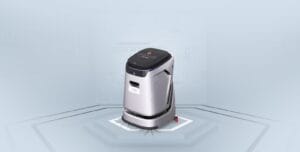
What Is the PUDU MT1?
The PUDU MT1 is an AI-powered autonomous sweeper designed for professional dry cleaning across large commercial spaces.
It combines traditional sweeping hardware with AI-powered trash recognition, autonomous navigation, and spot cleaning.
PUDU positions the MT1 for large venues and says it is designed to tackle areas of up to 100,000 square meters.
Its dual-disc brushes are designed to collect both fine dirt and larger debris, while a negative-pressure ventilation system and filter help control dust during operation.
The robot’s AI cameras can also recognize trash in real time.
Instead of treating every part of the facility exactly the same, the MT1 can identify debris and perform targeted spot cleaning where needed.
PUDU MT1 Cleaning Performance
According to PUDU and ServicePro’s current specifications, the MT1 can achieve:
Standard cleaning:
Up to 1,800 m²/h — approximately 19,375 ft²/h
Spot cleaning:
Up to 6,000 m²/h — approximately 64,583 ft²/h
Runtime:
Approximately 4–8 hours, depending on cleaning level
Waste capacity:
35 liters
Charging:
Less than 3 hours
Navigation:
VSLAM + Marker + LiDAR SLAM.
Those specifications make the MT1 a strong candidate for repetitive sweeping across large hard-floor areas.
Where Does the PUDU MT1 Fit Best?
The MT1 can make sense for facilities where the primary cleaning challenge is dry debris across large indoor areas.
Potential applications include:
- Warehouses
- Distribution centers
- Manufacturing facilities
- Logistics facilities
- Large retail environments
- Transportation facilities
- Other large commercial spaces
For example, a warehouse dealing primarily with dust, paper, packaging debris, dirt, and other loose material may not need a robot capable of multiple wet-cleaning functions.
It may simply need a reliable autonomous sweeper that can repeatedly cover large areas.
That’s where the MT1 becomes particularly interesting.
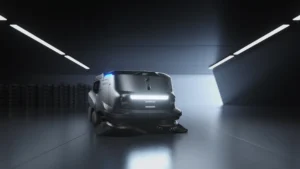
What Is the PUDU MT1 Max?
The PUDU MT1 Max builds on the MT1 platform but is designed for more demanding environments.
PUDU describes the MT1 Max as an AI-powered 3D perception robotic sweeper for complex large-scale environments.
Its biggest technological difference is the enhanced perception system.
The MT1 Max combines 3D LiDAR with multi-sensor fusion to create a more detailed understanding of the surrounding environment. PUDU says this allows it to maintain mapping and navigation in conditions including high ceilings, low-light environments, semi-outdoor spaces, and environments with significant interference.
That’s an important distinction.
The MT1 is already autonomous.
The Max is designed to make that autonomy more capable in complex and dynamic operating environments.
PUDU MT1 Max Cleaning Performance
The MT1 Max also increases cleaning productivity.
PUDU currently lists:
Cover cleaning:
Up to 2,200 m²/h — approximately 23,681 ft²/h
Spot cleaning:
Up to 7,000 m²/h — approximately 75,347 ft²/h
Runtime:
Approximately 5–10 hours
Standard-mode runtime:
Approximately 8 hours
Waste capacity:
35 liters
Cleaning width:
70 cm / 27.6 inches with side brush
Charging:
Less than 3.5 hours
Navigation:
VSLAM + Marker + 3D LiDAR SLAM.
So compared with the MT1, the Max provides greater potential cleaning coverage per hour and longer potential runtime.
But those aren’t necessarily its most important advantages.
Difference #1: Cleaning Productivity
The most straightforward difference is cleaning performance.
The MT1 provides up to:
1,800 m²/h standard cleaning
while the MT1 Max provides up to:
2,200 m²/h cover cleaning.
That’s approximately a 22% increase in maximum listed routine cleaning productivity.
For spot cleaning, the difference is:
MT1: up to 6,000 m²/h
MT1 Max: up to 7,000 m²/h.
Does that mean every facility should choose the Max?
Not necessarily.
Maximum specifications don’t represent every real-world environment. Facility layout, traffic, debris, obstacles, route complexity, and cleaning requirements can all affect actual productivity.
But when floor area becomes very large, additional cleaning capacity can become increasingly valuable.
Difference #2: Runtime
The second difference is operating time.
The MT1 is listed at approximately:
4–8 hours
depending on cleaning level.
The MT1 Max increases that range to:
5–10 hours, with approximately 8 hours in standard mode.
For a smaller application, that difference may not significantly affect the operation.
For a large distribution center or industrial facility requiring repeated cleaning over long shifts, however, additional runtime can become more valuable.
Difference #3: 3D Perception
This is arguably the biggest difference between the two robots.
The standard MT1 uses:
VSLAM + Marker + LiDAR SLAM.
The MT1 Max adds 3D LiDAR SLAM and multi-sensor fusion.
According to PUDU, its enhanced 3D perception helps the Max maintain reliable mapping and positioning across challenging environments such as:
- High ceilings
- Glass-roof areas
- Low-light environments
- Semi-outdoor spaces
- Environments with dust or other interference
PUDU also says the system enables more intelligent real-time path planning and dynamic obstacle avoidance.
For a predictable indoor environment, these capabilities may be less critical.
For a complicated industrial facility, parking structure, loading environment, or semi-outdoor area, they could become much more important.
Difference #4: Vehicle and Pedestrian Avoidance
Warehouses don’t operate in empty buildings.
Cleaning robots may need to share space with:
- Employees
- Forklifts
- Pallet jacks
- Carts
- Vehicles
- Equipment
- Temporary obstacles
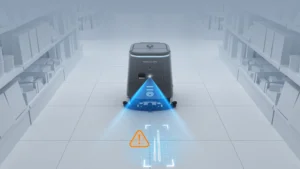
The MT1 Max introduces upgraded obstacle avoidance designed specifically for these kinds of dynamic situations.
For example, PUDU says the robot can stop to allow vehicles to pass, pause at lane entrances, or move toward the side while keeping traffic routes clear. It also has pedestrian and animal avoidance designed to respond to sudden movements.
That’s particularly relevant for warehouses and industrial facilities.
The question isn’t simply:
Can the robot navigate from Point A to Point B?
It’s:
How effectively can the robot operate while the facility continues functioning around it?
That’s an area where the MT1 Max has a clear technological advantage.
Difference #5: AI Adaptive Cleaning
Both robots incorporate AI into the cleaning process.
The MT1 uses AI cameras for trash recognition and targeted spot cleaning.
The MT1 Max takes the concept further.
Its AI adaptive cleaning system can adjust cleaning behavior based on the debris it detects.
PUDU describes the robot as automatically reducing power for lighter debris to avoid scattering it and increasing power for heavier debris. It can also adjust its cleaning posture to better guide debris into the brushes.
The Max also uses a dual-chip architecture designed to provide faster AI processing and built-in redundancy.
That gives the MT1 Max a more sophisticated approach to adapting its cleaning behavior to changing conditions.
Difference #6: Indoor vs. More Complex Environments
This distinction can make choosing between the two much easier.
The MT1 is designed for large-scale professional dry cleaning and is a strong option for large indoor venues.
PUDU specifically developed the MT1 Max to extend the platform into more complex indoor and semi-outdoor environments.
Examples given by PUDU include underground parking garages and semi-open building atriums.
The Max also carries IP54 protection and additional environmental and safety features, including rain detection and enhanced visual/audible warning systems.
That creates a useful distinction for buyers:
Predictable large indoor environment → MT1 may be sufficient.
Large, dynamic, complex, or semi-outdoor environment → MT1 Max deserves stronger consideration.
Which Is Better for a Warehouse: MT1 or MT1 Max?
This depends heavily on the warehouse.
Consider the MT1 if your facility:
- Primarily needs autonomous dry sweeping
- Has relatively predictable indoor conditions
- Needs to remove dust, dirt, packaging debris, and other loose material
- Has substantial open hard-floor space
- Doesn’t require the Max’s additional environmental perception capabilities
Consider the MT1 Max if your facility:
- Is particularly large
- Has heavy or changing traffic
- Regularly operates around vehicles or forklifts
- Has more complex navigation requirements
- Needs longer potential runtime
- Can benefit from greater cleaning productivity
- Contains semi-outdoor areas
- Has challenging lighting or environmental conditions
- Requires a more advanced obstacle-avoidance system
The important point is that “Max” shouldn’t automatically mean “better for everyone.”
The better robot is the one that fits the actual environment.
What About Distribution Centers?
Distribution centers can be particularly strong candidates for the MT1 series because they often combine:
- Large amounts of hard-floor space
- Long aisles
- Repetitive cleaning requirements
- Packaging debris
- Extended operating schedules
- Employees and vehicles moving throughout the facility
For a relatively controlled distribution environment, the MT1 may provide the necessary autonomous sweeping capability.
For a much larger or more dynamic operation with substantial vehicle traffic, the MT1 Max’s enhanced 3D perception and obstacle avoidance may provide additional value.
Again, this is something that should be tested in the actual facility rather than determined exclusively from a specification sheet.
Can the MT1 and MT1 Max Scrub Floors?
This is an important distinction.
The PUDU MT1 and MT1 Max are autonomous sweepers.
They’re designed primarily for dry cleaning and debris collection, not wet floor scrubbing. PUDU lists the MT1 Max’s cleaning capability specifically as sweeping.
If your primary problem is dirt or residue that needs to be washed from the floor, an autonomous scrubber may be more appropriate.
ServicePro offers other commercial cleaning robots designed for scrubbing and multi-function cleaning applications.
This is why identifying the actual cleaning problem should happen before selecting the robot.
How Should You Decide Between the MT1 and MT1 Max?
Specifications are useful, but they shouldn’t be the entire decision.
Before choosing between the MT1 and MT1 Max, evaluate:
1. Cleanable Floor Area
Don’t use the total square footage of the building.
Determine how much accessible floor area the robot will actually need to clean.
2. Debris
Identify what the robot will encounter most often.
Fine dust? Packaging debris? Paper? Leaves? Bottles? Mixed material?
3. Traffic
How frequently will employees, forklifts, vehicles, or equipment cross the robot’s route?
This can be particularly important when evaluating the Max’s enhanced perception capabilities.
4. Operating Environment
Is the robot staying entirely indoors?
Will it encounter semi-outdoor areas, variable lighting, dust, or more challenging environmental conditions?
5. Required Cleaning Time
How many hours per day does the robot need to operate?
A longer runtime becomes more meaningful as the amount of required cleaning increases.
6. Future Expansion
Are you automating one area today but potentially expanding across a much larger facility—or multiple facilities—later?
Your longer-term deployment plan can affect which platform makes more sense.
MT1 vs MT1 Max: Don’t Choose Based on Specifications Alone
A comparison table can tell you that the MT1 Max has higher listed cleaning productivity.
It can tell you that the Max has longer potential runtime.
And it can tell you that the Max incorporates enhanced 3D perception and obstacle avoidance.
But it can’t tell you exactly how either robot will perform inside your facility.
A real warehouse may contain narrow areas, changing pallets, forklift traffic, loading zones, floor transitions, debris, employees, and operational constraints that aren’t represented in a specification sheet.
That’s why a demonstration or proof of concept can be particularly useful for enterprise buyers.
Test the Robot in Your Actual Facility
Rather than guessing which robot will provide the best operational value, organizations can evaluate autonomous cleaning under real-world conditions.
A proof of concept can help answer questions such as:
How much floor area can the robot actually cover during our normal operation?
How effectively does it collect the debris found in our facility?
How does it respond to our traffic patterns?
How often does an employee need to interact with it?
How does autonomous cleaning fit into our existing workflow?
Could the solution scale to other areas or locations?
This shifts the decision from:
“Which robot has better specifications?”
to:
“Which robot produces better results for our operation?”
And that’s a much more useful question.
PUDU MT1 vs MT1 Max: Frequently Asked Questions
What is the main difference between the PUDU MT1 and MT1 Max?
The MT1 Max provides higher maximum cleaning productivity, longer potential runtime, enhanced 3D perception, upgraded obstacle avoidance, AI adaptive cleaning, and additional capabilities designed for more complex indoor and semi-outdoor environments. The MT1 remains a capable autonomous sweeper for large-scale indoor dry cleaning.
Is the MT1 Max faster than the MT1?
In terms of listed maximum cleaning productivity, yes. The MT1 provides up to 1,800 m²/h in standard cleaning mode, while the MT1 Max provides up to 2,200 m²/h in cover cleaning. Maximum spot-cleaning performance increases from 6,000 m²/h to 7,000 m²/h.
Does the MT1 Max have longer battery life?
The MT1 is listed with approximately 4–8 hours of runtime depending on cleaning level. The MT1 Max is listed at approximately 5–10 hours, with around eight hours in standard mode. Actual runtime will depend on operating conditions.
Which is better for a large warehouse?
Both can be relevant for warehouses. The MT1 can be appropriate for large indoor areas requiring autonomous dry sweeping. The MT1 Max deserves stronger consideration for particularly large, busy, or complex facilities where its additional cleaning productivity, runtime, 3D perception, and dynamic obstacle avoidance can provide value.
Can the MT1 Max operate around forklifts?
The MT1 Max includes enhanced dynamic obstacle avoidance. PUDU specifically describes behaviors for vehicle traffic, such as stopping to allow vehicles to pass and pausing at lane entrances. Actual suitability should still be evaluated within the facility’s specific traffic environment.
Can the MT1 or MT1 Max scrub floors?
They’re primarily autonomous sweepers. If the facility requires wet scrubbing, ServicePro offers other robotic cleaning solutions designed for that purpose.
Can we test the MT1 or MT1 Max before making a larger deployment decision?
For an enterprise deployment, a demonstration or proof of concept can be a useful way to evaluate cleaning performance, navigation, facility compatibility, and operational impact before deciding whether to scale.
PUDU MT1 or MT1 Max: Which One Should You Choose?
Both robots address the same fundamental challenge:
automating repetitive sweeping across large commercial and industrial spaces.
The PUDU MT1 provides autonomous sweeping, AI trash recognition, spot cleaning, a 35-liter waste capacity, and up to 1,800 m²/h of standard cleaning performance.
The PUDU MT1 Max expands that platform with higher cleaning productivity, longer potential runtime, enhanced 3D perception, more sophisticated obstacle avoidance, AI adaptive cleaning, and capabilities intended for more complex environments.
So the decision shouldn’t simply be:
MT1 vs. MT1 Max — which has better specifications?
It should be:
Which robot is better suited to the facility we’re actually trying to clean?
For some operations, the MT1 may provide exactly the autonomous sweeping capability required.
For larger, more dynamic, or more complex environments, the additional capabilities of the MT1 Max may justify moving to the more advanced platform.
Not Sure Whether the MT1 or MT1 Max Is Right for Your Facility?
ServicePro Robotics can help evaluate your facility, cleaning requirements, floor area, traffic patterns, and automation goals to determine which solution makes the most sense.
Instead of choosing from specifications alone, you can evaluate how autonomous cleaning could perform in your actual environment.
Request a Demo
Talk to an Automation Specialist
Request a Proof of Concept
Explore PUDU MT1 at ServicePro Robotics