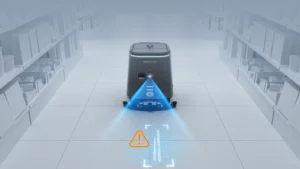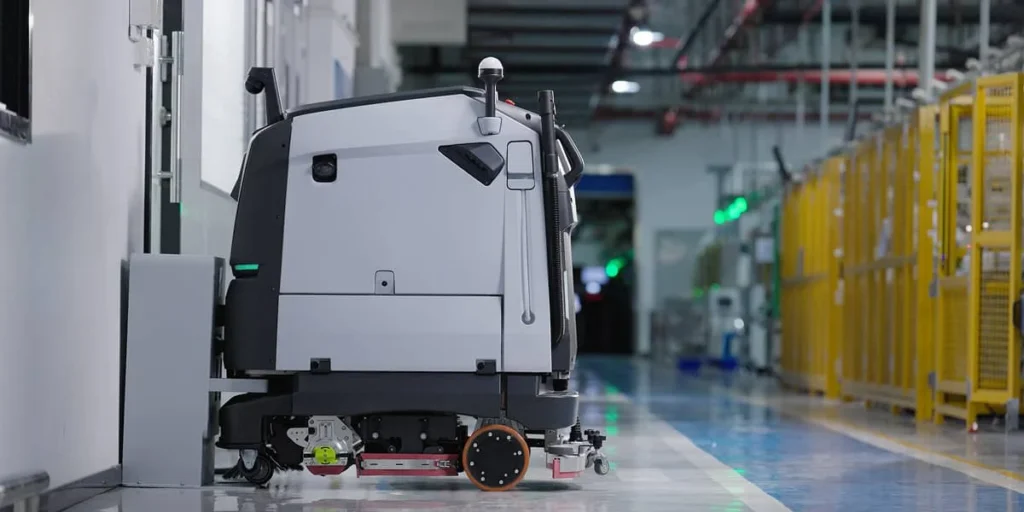
Commercial cleaning robots can operate on many of the flooring surfaces commonly found in warehouses, retail stores, hospitals, schools, hotels, offices, and other large facilities.
However, the right cleaning method depends on the surface. A robot designed primarily for sweeping a warehouse floor may not be the best choice for cleaning carpet, while a multi-purpose robot can switch between scrubbing, vacuuming, sweeping, and mopping.
Understanding your floor types is therefore one of the most important steps when selecting a commercial cleaning robot.
Tile Floors
Tile is one of the most common surfaces for commercial cleaning robots.
Robotic scrubbers can apply water and cleaning solution, agitate the floor with a brush, and collect the dirty water during the same cleaning cycle. This makes them suitable for locations such as:
- Grocery stores
- Shopping centers
- Hospitals
- Schools
- Airports
- Restaurants
- Hotel lobbies
Autonomous cleaning robots can also follow scheduled routes and repeatedly clean high-traffic areas without requiring an employee to manually operate the machine.
For tile floors with deep grout lines, the appropriate brush pressure and cleaning configuration should be selected during the initial site assessment.
Polished and Sealed Concrete
Commercial cleaning robots can clean polished and sealed concrete floors found in warehouses, manufacturing facilities, distribution centers, parking structures, and large retail environments.
The ideal robot depends on the type of debris present.
A robotic sweeper such as the PUDU MT1 is designed for large-scale dry-floor cleaning and can collect dust, paper, packaging material, and other loose debris. For stains, spills, or dirt attached to the surface, a robotic scrubber may be more appropriate.
Facilities that have both loose debris and frequent stains may benefit from combining scheduled sweeping with periodic scrubbing.
Vinyl and Luxury Vinyl Tile
Vinyl and luxury vinyl tile, commonly known as LVT, can generally be cleaned by commercial robots using mopping, sweeping, vacuuming, or light scrubbing modes.
These surfaces are common in:
- Healthcare facilities
- Schools
- Offices
- Retail stores
- Senior living communities
- Apartment buildings
The cleaning settings should match the floor manufacturer’s care recommendations. Excessive brush pressure or an unsuitable cleaning chemical could affect certain finishes, so the robot should be configured according to the specific flooring material.
Linoleum Floors
Linoleum floors can also be maintained with autonomous mopping and scrubbing equipment.
Because linoleum can be sensitive to excessive moisture and highly alkaline cleaning products, the cleaning solution, water volume, and brush pressure must be properly configured.
A professional site assessment can determine the safest cleaning mode before the robot begins operating on a regular schedule.
Epoxy Floors
Epoxy-coated floors are frequently used in warehouses, industrial facilities, commercial kitchens, garages, healthcare environments, and manufacturing plants.
Depending on the condition and texture of the surface, robots can:
- Sweep loose debris
- Vacuum dust and smaller particles
- Scrub stains and attached dirt
- Collect water after cleaning
Smooth epoxy surfaces are generally easier for autonomous robots to navigate. Textured or anti-slip epoxy may require a more aggressive brush or a machine specifically configured for that surface.
Carpet
Some commercial cleaning robots can clean low-pile carpet, but the machine must support a vacuuming mode or use the appropriate carpet-cleaning attachment.
For example, the PUDU CC1, offered by ServicePro as Oscar, can clean hard floors and soft carpet. Carpet cleaning requires its separate carpet vacuuming assembly.
Oscar can also automatically use sweep-and-vacuum cleaning on hard surfaces and switch to vacuum-only operation on carpet.
This makes a multi-purpose robot useful in buildings with transitions between surfaces, such as:
- Office hallways with carpeted rooms
- Hotels with tiled lobbies and carpeted corridors
- Retail stores with entrance mats
- Conference centers
- Libraries and educational facilities
Thick, loose, or high-pile carpets should be evaluated before deployment, as they may require specialized equipment.
Hardwood and Laminate
Certain commercial cleaning robots can operate on sealed hardwood and laminate floors using vacuuming, sweeping, dust-mopping, or low-moisture cleaning modes.
Wet scrubbing should only be used when it is permitted by the flooring manufacturer. Too much water could enter seams or affect the floor’s protective finish.
For these surfaces, a dry or low-moisture cleaning configuration is usually more appropriate than aggressive scrubbing.
Natural Stone
Commercial robots can clean sealed natural-stone surfaces such as marble, granite, terrazzo, and some types of polished stone.
However, the cleaning chemical must be compatible with the material. Acidic products can damage certain stone surfaces, while aggressive brushes may affect polished finishes.
The robot’s cleaning solution, brush type, pressure, and water flow should be tested in a small area before a full cleaning route is launched.
Rubber Flooring
Rubber flooring is common in gyms, healthcare facilities, schools, playground areas, and industrial environments.
Cleaning robots may be able to vacuum, sweep, mop, or scrub these surfaces, depending on the floor texture and the equipment being used.
Textured rubber floors can create more resistance than smooth surfaces, so they may need a specific brush configuration and a slower cleaning route.
Can One Robot Clean Different Floor Types?
Yes. Some multi-purpose commercial cleaning robots can transition between different surfaces and use different cleaning modes.
The PUDU CC1 combines sweeping, scrubbing, vacuuming, and mopping in one machine. It is designed for both hard floors and soft carpet when equipped with the required carpet accessory.
ServicePro’s Oscar can also adjust its cleaning operation based on the surface, using different modes for hard floors and carpet.
For larger industrial environments, a dedicated sweeper such as the MT1 may be more suitable for controlling dry debris across expansive warehouse or manufacturing floors.
The best solution depends on:
- Total cleaning area
- Floor materials
- Amount and type of debris
- Frequency of spills
- Required cleaning schedule
- Width of aisles and doorways
- Presence of ramps, elevators, or floor transitions
- Whether cleaning occurs around employees or customers
Schedule a Floor Assessment
Commercial cleaning robots can maintain tile, concrete, vinyl, epoxy, carpet, stone, and several other common surfaces. The key is choosing the robot and cleaning configuration that match the facility.
ServicePro can assess your flooring, cleaning area, obstacles, traffic patterns, and operational needs before recommending a solution.
Schedule an on-site demonstration to see how an autonomous cleaning robot performs on your facility’s actual floors.