Once a cleaning robot looks like a good fit for your facility, a second decision follows: should you buy it or lease it? This guide is for facilities, custodial, maintenance, and operations leaders, along with the finance colleagues who will review the paperwork, who need to compare those two routes for a warehouse, plant, school, or other large commercial property.
The short answer is that buying tends to suit organizations that expect to keep a robot in service for years and are ready to manage its upkeep. Leasing tends to suit organizations that want to limit the upfront outlay or keep more room to change course. Either way, the monthly payment tells you very little on its own. What matters is what the contract commits you to, who looks after the robot, and what happens when the term ends.
If you are still working out what a robot costs, start with our commercial cleaning robot pricing guide. This article picks up from there and focuses on the contract decision: what to compare, what to verify, and what to ask before you sign.
Buying vs. Leasing at a Glance
Use this table as a starting point. These are general tendencies rather than rules, and any specific agreement can differ.
| Factor | Buying tends to fit when | Leasing tends to fit when |
|---|---|---|
| Budget | Capital is available or already approved | Upfront capital is limited or needed elsewhere |
| Time in service | You expect to run the robot for years at a stable site | Your needs may change, or a site has an uncertain future |
| Upkeep | Your team is ready to manage maintenance, parts, and service calls | You want service costs in one agreement, and the contract actually provides that |
| Technology | You are comfortable keeping a model through its working life | You want a defined point to return or replace it |
| Procurement | Your organization prefers a one-time purchase | Your organization prefers budgeting for scheduled payments |
Five Things to Compare Before You Decide
1. Ownership: Who Holds Title, and When?
When you buy, the robot is yours once the sale completes. You decide how long to run it, where to use it, and whether to resell it. With a lease, the leasing company typically owns the robot during the term, and the agreement sets the rules for how you use it. Ownership may or may not transfer at the end, depending on the structure.
Check whether the agreement restricts moving the robot to another building, and who carries insurance and liability for loss or damage during the term. This matters most for operators who expect to shift equipment between properties.
2. Contract Length: How Long Are You Committed?
A purchase has no term to manage. A lease usually runs for a fixed number of months, with payments due through the end of the term even if the robot ends up being used less than you planned.
Compare the proposed term with something concrete in your operation, such as the years remaining on a building lease, a customer contract, or a budget cycle. Then ask what it would cost to exit early. Ending a lease ahead of schedule can carry fees or require paying much of the remaining balance, so a lease is not automatically the flexible option.
3. Service: Who Is Responsible When the Robot Needs Attention?
This is the easiest point to misjudge. A lease is primarily a way to pay for equipment, and it does not automatically include service. Some agreements bundle support, while others leave maintenance and repairs with you or place them under a separate plan. Confirm each of these in writing:
- Preventive maintenance: what is scheduled, how often, and who performs it.
- Wear parts and consumables: who pays for items such as brushes, squeegees, and filters.
- Repairs and downtime: how support requests are handled and what happens if the robot is out of service.
- Software and support: whether updates or remote support carry a separate charge.
- Warranty: what it covers, how long it lasts, and whether it runs through the full lease term. If it ends first, you could be paying for repairs while still making lease payments.
Your own team will also have routine work to do, whichever route you choose. Our commercial cleaning robot maintenance guide explains what that looks like day to day.
You may also see offers described as a subscription or Robots-as-a-Service. These are often positioned as a bundle of the robot and its support, which makes them different from a conventional lease, but labels vary. Whatever a supplier calls the agreement, go by what the contract says is included.
4. Total Contractual Cost: What Will You Pay Across the Full Term?
A lower monthly payment can sit on top of a higher total. Add up every amount the agreement requires, including:
- Purchase price or the full run of lease payments
- Deposits, documentation fees, and other amounts due at signing
- Delivery, site mapping, setup, and training
- Service plans, consumables, and any required insurance
- Scheduled payment increases, if any
- Buyout, return shipping, or reconditioning charges at the end of the term
This step compares two ways of paying for the same robot. Whether the robot justifies its cost is a separate question, covered in our guide to building a cleaning robot business case.
5. End-of-Term Options: What Happens When the Contract Ends?
Many equipment leases follow one of the structures below, though names and terms vary between leasing companies.
| Structure | Typical end-of-term outcome | What to verify |
|---|---|---|
| Fair market value (FMV) lease | Return the equipment, renew, or buy it at its fair market value | How fair market value is determined, and by whom |
| $1 or fixed-price buyout lease | Take ownership for the agreed price | Total payments compared with buying outright |
| Subscription or rental agreement | Usually renew or return | Minimum term, inclusions, and return costs |
Also check whether you must give written notice before the term ends and whether the agreement renews automatically if you do not. If you plan to return the robot, ask what counts as normal wear, what condition the batteries and components must be in, and who pays for removal.
An Illustrative Cost Comparison
The example below uses invented round numbers to show the method. These are not ServicePro prices, quotes, or financing terms, and they are not intended to represent typical market rates.
Imagine a facility comparing a purchase with a 48-month lease of the same robot, with a separate four-year service plan in both cases.
| Illustrative cost | Purchase | 48-month lease |
|---|---|---|
| Equipment | $40,000 upfront | $1,100 × 48 = $52,800 |
| Delivery, setup, and training | $2,000 | Included in payments |
| Four-year service plan | $8,000 | $8,000 |
| Total for four years of use | $50,000 | $60,800 |
| Buyout to keep the robot | Not applicable | $4,000 |
| Total if you keep the robot | $50,000 | $64,800 |
Here, the purchase costs $14,800 less if the facility keeps the robot. It also requires $42,000 before the robot has cleaned a single square foot, while the lease spreads those costs over four years. If the facility planned to return the robot instead, it would compare $60,800 with $50,000 minus whatever an owned four-year-old robot could realistically be resold for.
The numbers alone do not settle the decision. Your finance team may also weigh the value of keeping cash available, the cost of borrowing, and the option to walk away at the end of the term. The useful step is to put real quotes into the same format so that you are comparing like with like.
Comparing real options for your site? Discuss the right cleaning robot and purchasing options for your facility with ServicePro.
Three Illustrative Scenarios
These hypothetical examples show how the same questions can point in different directions.
A Warehouse With a Long-Term Site
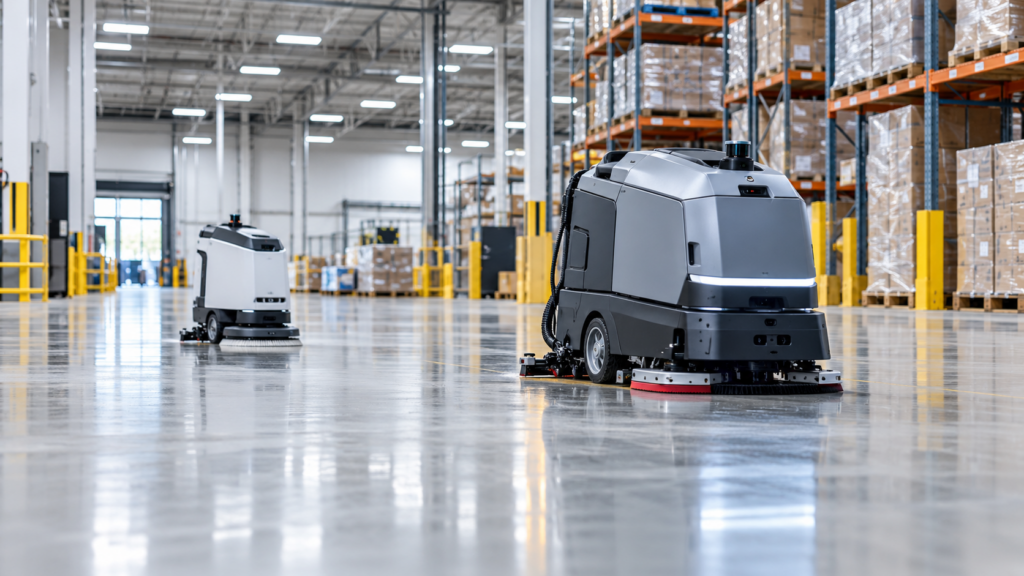
A distribution warehouse owns its building, has tested a robot on its floors, expects the layout to stay stable for years, and has a maintenance team that is comfortable with routine upkeep. Buying may deserve the first look here, because the flexibility of a lease has less value when little is likely to change.
A Logistics Operator With a Three-Year Customer Contract
A third-party logistics provider runs a site under a three-year customer contract. If that contract is not renewed, the robot may no longer be needed there. A lease that aligns with the contract, or a clear right to move the robot to another site, could be worth paying for. The early-exit and relocation terms are the clauses to read first.
A School District Starting in Two Buildings
A district wants to begin in two buildings and expand if the robots work well. Its business office may have rules on multi-year commitments, board approval, and funding sources, and those rules could settle the question before any cost comparison does. It is worth confirming them early and asking whether additional units could be added later on similar terms. Our article on cleaning robots for multi-location operations covers the wider operational case.
What Leasing Will Not Solve
- A poor site fit. A lease on the wrong robot is still a commitment. Confirm the fit first with a structured robot demo or, for larger deployments, a Proof of Concept.
- Daily operating responsibilities. Someone on site still needs to handle routine tasks and respond when the robot asks for help.
- Financing uncertainty. Lease terms and approval generally depend on the financing provider, the transaction, and your organization, so an example or estimate is not an offer.
- Accounting and tax questions. Treatment can depend on how an agreement is structured and on your circumstances. This article is general information rather than tax, legal, or accounting advice, so have your own advisers review any agreement before you sign.
Questions to Ask Your Supplier Before You Sign
For Either Option
- Which models can we buy, lease, or both?
- Are delivery, site mapping, setup, and training included?
- What does the warranty cover, for how long, and what does it exclude?
- Who provides service, and how are support requests handled?
- Which wear parts and consumables are our responsibility?
If You Are Leasing
- Who is the leasing company: the supplier or a third-party finance provider?
- What is the term, and what is the total of all required payments?
- Can we exit early, and what would that cost?
- What are our end-of-term options, and how is any buyout price set?
- Is written notice required to avoid automatic renewal?
- What are the return conditions, and who pays for removal or shipping?
- Can the robot move to another site, and can we add units on similar terms?
If You Are Buying
- What support is available after the warranty ends?
- How are replacement parts sourced, and who performs repairs?
- Which software or support services continue after the initial period, and do they carry a recurring cost?
Common Questions About Leasing a Cleaning Robot
Are there leasing options for autonomous floor scrubbers?
Yes, leasing is one way businesses acquire this equipment, and ServicePro offers purchase and leasing options across its commercial robot lineup. Availability and terms can depend on the robot and the deployment, so confirm them for the specific model. You can start by browsing our autonomous floor scrubbers or autonomous sweepers, such as the PUDU MT1.
Can you lease to own a floor scrubber?
Some agreements transfer ownership at the end of the term or include a purchase option. Ask for the structure in writing, including the buyout price or how it will be calculated, and compare the total you would pay with the price of buying outright.
Does a lease include maintenance?
Not automatically. Some agreements include service and others do not, so treat maintenance as a line item to verify rather than an assumption.
Can we start with a lease and buy later?
Possibly. That depends on the end-of-term options or any early purchase right in your agreement. If this is your plan, settle it before signing so that the price or formula is documented from the start.
What to Share So ServicePro Can Advise You
You do not need exact figures or a final decision to start the conversation. Approximate details are enough to help us point you in the right direction:
- Facility type and approximate cleaning area: for example, a 200,000-square-foot warehouse or a group of school buildings.
- Floor surfaces and cleaning tasks: such as sealed concrete, tile, or carpet, and whether you need sweeping, scrubbing, or vacuuming.
- Operating schedule: when the robot could run and how your shifts are organized.
- Interest in purchasing or leasing: whether you lean one way or would like to compare both.
Discuss the Right Cleaning Robot and Purchasing Options for Your Facility
The right structure starts with the right robot for your site. ServicePro can review your facility, discuss suitable models, and talk through the purchasing and leasing options available for them, so you can compare your choices with the right questions in hand.
Prefer to send a message first? Contact ServicePro and tell us about your facility.