The number of cleaning robots a large facility needs depends on four things: how much floor actually needs cleaning, how often, how fast a robot really covers that floor in your building, and how many hours it can work in the time you have. It does not depend on how big the machine is. A heavy scrubber-dryer is not automatically the right choice for a large building, and a compact robot is not automatically too small. Start with your cleaning requirements, estimate the robot-hours they need, and then confirm the estimate on your own floors.
This guide is for facilities, maintenance, sanitation, and operations leaders planning commercial cleaning robots for warehouses, manufacturing plants, schools, and large commercial properties. It shows a simple way to size a robot fleet, explains which site factors change the answer, and lists what to verify during a demonstration.
Large Robot vs. Robot for a Large Area
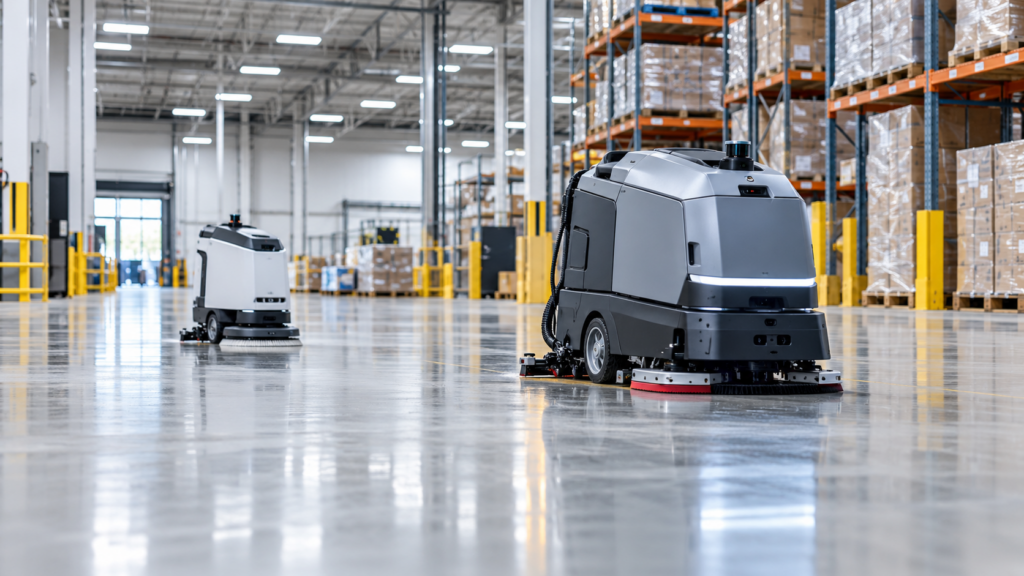
A physically large cleaning robot is one with a big body, wide cleaning path, and large tanks or bins, such as a ride-on-sized scrubber-dryer. A robot suited to a large floor area is one that can cover your required square footage within your cleaning window, on your floor type, with an acceptable amount of staff support. The two overlap, but they are not the same thing.
Published specifications for three PUDU models that ServicePro supplies show the difference. The PUDU BG1, a large scrubber-dryer, weighs about 344 kg (758 lb). The PUDU CC1 Pro, sold by ServicePro as Oscar Pro, weighs 75 kg (165 lb). The PUDU MT1 sweeper weighs 65 kg (143 lb). Yet the lightest of the three, the MT1, lists a higher standard-mode coverage rate than the CC1 Pro, because dry sweeping is a different task from wet scrubbing. Machine size tells you little until you know the job.
Larger machines do bring real advantages on big, open hard floors: wider paths, bigger water tanks, and longer runs between refills. They also need wider aisles, more space to turn and dock, and more care in mixed pedestrian areas. Smaller robots fit tighter spaces and more floor types, but may need more robots or longer hours to cover the same area.
Published Specifications Compared
The table below compares manufacturer-published figures. It is not a ranking. The models do different jobs, and manufacturers measure coverage in different modes and conditions, so treat these numbers as upper limits to test, not as planning rates.
| Specification (manufacturer-published) | PUDU CC1 Pro (Oscar Pro) | PUDU MT1 | PUDU BG1 |
|---|---|---|---|
| Robot type | Multi-purpose: sweeping, scrubbing, vacuuming (including carpet), dust mopping | Sweeper (dry cleaning) | Large sweeper-scrubber-dryer |
| Weight | 75 kg (165 lb) | 65 kg (143 lb) | About 344 kg (758 lb) |
| Cleaning width | 500 mm (19.7 in) with side brush | 70 cm (27.6 in) practical cleaning width | 550 mm (21.7 in); 708 mm (27.9 in) with side brushes |
| Minimum path clearance | 70 cm (27.6 in) | 75 cm (29.5 in) | 85 cm (33.5 in) |
| Coverage, full-coverage cleaning | 700–1,000 m²/h (about 7,500–10,800 ft²/h) | Max 1,800 m²/h (about 19,400 ft²/h), standard mode | Max 2,000 m²/h (about 21,500 ft²/h), covered mode |
| Coverage, spot-cleaning mode | 1,500–3,000 m²/h | Max 6,000 m²/h | Max 6,000 m²/h |
| Run-time per charge | Scrubbing 5 h; sweeping and vacuuming 5 h; carpet vacuuming 4 h; silent mopping 9 h | 4–8 h, depending on cleaning level | Sweeping and scrubbing: max 7.5 h |
| Charging time | About 3 h | Under 3 h | About 3 h (AC ≥ 180 V); about 4.5 h (AC ≤ 180 V) |
| Tanks or bin | 15 L clean water, 15 L dirty water; 2.5 L dustbin | 35 L trash bin | 75 L clean water, 60 L waste water; 5 L trash bin |
| Unattended charging and servicing | Auto charging and water refill/drain with optional docking station | Auto-emptying with optional station | Auto refill, drainage, and charging with optional workstation |
Note the gap between full-coverage and spot-cleaning rates. In spot mode, a robot patrols and cleans only the messes it detects, so it “covers” far more floor per hour than when it cleans every square foot. If your requirement is a full scrub of every aisle each night, plan from the full-coverage figure, and then measure the real rate on site.
How to Estimate the Number of Robots
A first estimate takes three numbers and one division. It is a starting point for a site assessment, not a quote.
- Cleanable area per cycle. Measure the floor the robot will actually clean in one cycle, not the building’s total square footage. Subtract racking and equipment footprints, blocked zones, carpeted areas a scrubber cannot handle, and areas cleaned less often.
- Realistic coverage rate. Use the rate the robot achieves in your layout, including turns, edge passes, and slowdowns around people. Until you have a demo measurement, use the manufacturer’s full-coverage figure as a ceiling, and expect less in narrow or cluttered areas.
- Usable robot-hours per robot. Start with your cleaning window, then subtract time for recharging, water refill and drain, emptying bins, and travel to the dock. Run-time per charge, not the window alone, often sets the limit.
Robots needed = (cleanable area ÷ realistic coverage rate) ÷ usable robot-hours per robot, rounded up.
Worked example (hypothetical figures)
The figures below are invented to show the method. They do not describe any specific robot or customer.
A 150,000 ft² distribution center wants its aisles, dock, and staging areas wet-scrubbed every night between 10 p.m. and 6 a.m. After excluding racking footprints and offices, about 90,000 ft² of sealed concrete needs scrubbing each night. During a demonstration, a scrubber averages 12,000 ft² per hour in those aisles. After allowing for water refills, drainage, and trips to the dock, the team plans on 6 usable hours per robot per night.
- Robot-hours needed: 90,000 ÷ 12,000 = 7.5 hours
- Robots needed: 7.5 ÷ 6 = 1.25, rounded up to 2 robots
The measured rate matters most. At 8,000 ft² per hour, the same floor needs 11.25 robot-hours, which is still 2 robots. At 6,000 ft² per hour, it needs 15 robot-hours, or 3 robots. The team also has alternatives to buying a second robot: scrub high-traffic zones nightly and the rest on alternate nights, or run part of the route during a quieter day shift if traffic allows.
Factors That Change the Answer
Cleanable floor area and layout
Long, open runs let a robot hold its speed and full cleaning width. Short aisles, many turns, dead ends, and cluttered staging areas lower the real coverage rate. Map how the floor is divided: a building with one large open zone behaves very differently from one with dozens of small rooms connected by doors. If the robot has to travel between zones, floors, or buildings, that travel time comes out of its cleaning hours.
Floor surfaces and condition
Scrubber-dryers are made for hard floors such as sealed concrete, epoxy, vinyl, and tile. Carpet needs vacuuming, which multi-purpose robots such as the CC1 Pro can do in a separate mode. Floor condition matters as much as material: cracks, expansion joints, floor drains, ramps, thresholds, and uneven surfaces can affect navigation and squeegee pickup. Our guide to which floors commercial cleaning robots can clean covers surfaces in more detail.
Debris and cleaning requirements
Define what “clean” means for each area. Loose dust, packaging scraps, and litter call for sweeping. Tire marks, grime, and spills call for scrubbing. Some areas need both, either from two robots or from a sweeper-scrubber that does both in one pass. Heavy oil, fine powders, metal shavings, liquids from processes, and sanitation requirements in regulated areas all need an on-site evaluation before any robot is chosen.
Scrubbing vs. sweeping or vacuuming
Sweeping is usually faster per hour than scrubbing because there is no water to apply and recover. In the published figures above, the MT1 sweeper lists a higher standard-mode rate than the CC1 Pro’s full-coverage rate. If your floor mainly collects dry debris, a sweeper may cover a large area with fewer robots. If it needs wet cleaning, plan around scrubbing rates and water capacity. See robotic floor scrubber vs. robotic sweeper for a full comparison.
Aisle widths, obstacles, and traffic
Compare the narrowest aisle the robot must pass with its published minimum path clearance, which ranges from 70 cm (27.6 in) for the CC1 Pro to 85 cm (33.5 in) for the BG1. Leave margin for pallets, carts, and goods that sit in aisles. Commercial cleaning robots detect and avoid people and obstacles, but forklift routes, blind corners, dock doors, and busy shift changes still need planning. Decide which zones the robot cleans when people are present and which it cleans only after hours.
Operating schedule, charging, and water management
Work out where the dock or workstation will sit, whether it needs water supply and drainage, and how far the robot travels to reach it. Charging time is significant: the three PUDU models above list charging times from under three hours (MT1) to about three hours, or about 4.5 hours for the BG1 on lower-voltage power. For scrubbers, tank capacity often sets the limit before the battery does, because the robot must stop to refill clean water and empty dirty water. Unattended refill and drainage on these models require optional stations. Our guide to cleaning robot scheduling and route learning explains what to check.
Maintenance, training, and support
More robots means more daily care: emptying bins, cleaning squeegees and brushes, checking pads, and replacing consumables. Decide who on your team owns these tasks on each shift, and how quickly faults get support. ServicePro handles delivery, setup, configuration, and staff training, and offers maintenance packages with remote assistance or on-site service. Our commercial cleaning robot maintenance guide covers routine tasks.
When a Site Assessment Is Needed
A desk estimate is not enough in these situations. Each needs an on-site look before you choose a robot or a robot count:
- Food production, wet process areas, or other areas with sanitation rules
- Oil, chemicals, fine powders, or metal debris on the floor
- Ramps, slopes, loading docks, or outdoor sections
- Very narrow or frequently blocked aisles
- Heavy forklift traffic during the planned cleaning window
- Weak Wi-Fi or cellular coverage, or access-controlled doors and elevators
- Extreme temperatures, such as cold storage
What to Validate During a Facility Demonstration
A demonstration in your building is where the estimate becomes a plan. Use it to replace assumptions with measurements.
| What to check | How to check it | Why it matters for sizing |
|---|---|---|
| Real coverage rate | Time the robot over a measured, representative section in the cleaning mode you need | This is the number your robot count depends on |
| Run-time and refill intervals | Note when it needs charging, water refill, drainage, or bin emptying | Shows the usable hours per robot in your window |
| Narrowest aisles and turns | Send the robot through your tightest real routes, with goods in place | Areas the robot cannot reach must be cleaned another way |
| Cleaning result | Inspect edges, corners, wet pickup, and debris left behind | Extra passes or manual touch-ups reduce effective coverage |
| Behavior around traffic | Watch it with people, carts, and forklifts at realistic times | Decides which hours the robot can actually work |
| Dock and station placement | Confirm power, water, drainage, and travel distance | Long trips to the dock cut cleaning time |
| Staff workload | Count the daily tasks your team must do per robot | Affects how many robots your team can support |
For a fuller list of questions, see our cleaning robot demo checklist.
Which Robots to Consider for Large Areas
ServicePro supplies several categories of commercial cleaning robots. Which one fits depends on the requirements above, not on a single “best” model:
- Large hard floors that need wet cleaning: autonomous floor scrubbers, including large scrubber-dryers such as the PUDU BG1.
- Large floors with mostly dry debris: autonomous sweepers such as the PUDU MT1.
- Mixed floors, including carpet, or buildings with many smaller areas: multi-purpose cleaning robots such as Oscar Pro.
Once you know how many robots you need, compare leasing vs. buying and review our commercial cleaning robot pricing guide.
Get a Robot Count for Your Facility
To get a first sizing estimate from ServicePro, share four things with our team: your facility type, your approximate cleanable area, your floor surfaces, and your cleaning requirements, including how often each area is cleaned and the hours available. We will suggest robot types and a starting robot count, then confirm them with a demonstration at your site. Schedule a demo or call (561) 918-1412.
ServicePro is currently offering $1,500 off your first robot, whether you purchase or lease. See the offer page for details.
Specification Sources
Model specifications in this article come from PUDU’s published product pages for the CC1 Pro, MT1, and BG1 Series, checked in November 2026. Specifications can change and may vary by configuration and optional equipment, so confirm the current details for the exact model you are quoted. The worked example uses hypothetical figures to illustrate the method.